 The Good Part
The Great Stink: The Smell That Built London's Sewers
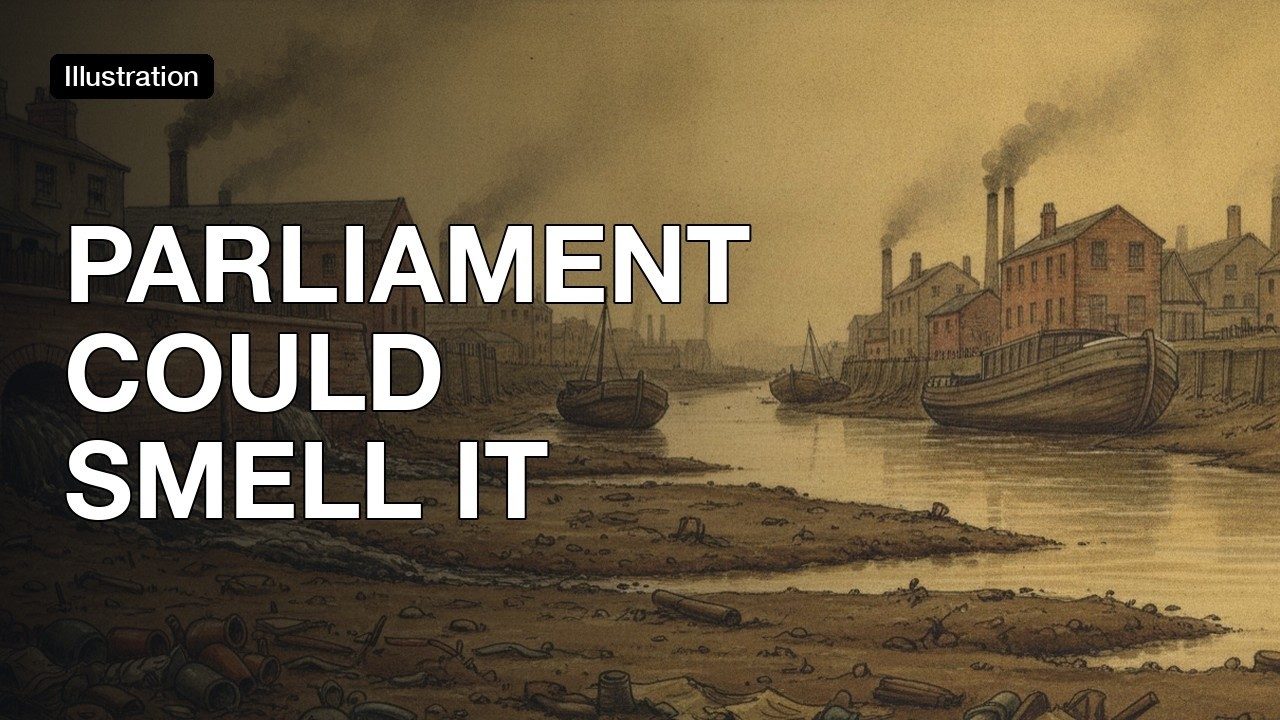
Parliament's curtains were soaked in lime. Not for decoration. To fight a smell. By June, the stench from the Thames had become so bad that business in Parliament was affected. On the river side of the building, the curtains were drenched in lime chloride. It failed. There was even talk of moving the business of government to Oxford, or St Albans. This is the story of how a smell did what years of dying could not.
The Great Stink struck central London in July and August 1858. Hot weather made the smell of untreated human waste and industrial effluent on the banks of the Thames far worse. But this was no sudden disaster. The problem had been mounting for several years. London's sewers were ageing and inadequate, and they emptied straight into the river. Here is the argument of this film. London fixed its sewers only when Parliament could smell the river.
How did the river get like this? In the century before 1856, over a hundred sewers were built in London. By then the city had around 200,000 cesspits and 360 sewers. Flushing toilets arrived. The population rose from just under one million to three million. More water went down the drains, carrying more waste. Factories and slaughterhouses added their own. Much of it ended up in the Thames.
In July 1855 the scientist Michael Faraday wrote to The Times. He had dropped pieces of white paper into the river to 'test the degree of opacity'. His verdict was blunt: 'the whole river was for the time a real sewer.' In 1857 the smell was so bad that the government poured chalk lime, chloride of lime and carbolic acid into the water. They treated the stink. Not the cause.
Why treat the smell? Because Victorian medicine believed the smell was the danger. Under miasma theory, most communicable diseases came from breathing contaminated air: the odour of sewage, of rotting corpses, even a sick person's breath. Most people believed miasma carried cholera. And cholera was deeply feared, for the speed of its spread and its high fatality rates. The reformer Edwin Chadwick put it plainly: 'all smell is disease'.
London had already paid for that belief in lives. Its first major cholera epidemic struck in 1831 and killed 6,536 people. A second outbreak, in 1848–49, killed 14,137. A third, in 1853–54, killed 10,738. Each of those outbreaks was blamed on the state of the river. Everyone could see the Thames was the problem. What they could not agree on was how it killed.
One man read the deaths differently. During the second outbreak, a London physician named John Snow noticed that death rates were higher where water came from the Lambeth and the Southwark and Vauxhall companies. In 1849 he published a paper, On the Mode of Communication of Cholera. It argued that the disease travelled through water, not air. Little attention was paid to it.
Then came Soho. On 31 August 1854, cholera broke out around Broad Street. Over the next three days, 127 people on or near the street died. By the end of the outbreak, 420 people were dead. Snow talked to residents and traced the deaths to a single public water pump. The parish authorities were persuaded to disable it. They removed its handle.
It was later found that the well had been dug three feet from an old cesspit that had begun to leak. Sewage, straight into drinking water. But once the epidemic subsided, officials put the handle back. They rejected Snow's theory. The Board of Health blamed the 1854 epidemic on miasma. The evidence existed. The will to act on it did not.
Worse, the fear of bad air made the river dirtier. Because of the fear that miasma from the sewers would spread disease, Chadwick and his successor, the pathologist John Simon, had the sewers regularly flushed through. The result was more sewage pouring into the Thames. The authorities were clearing the air of the streets by emptying it into the water.
Into this mess stepped an engineer. In August 1849, Joseph Bazalgette was appointed assistant surveyor to the Metropolitan Commission of Sewers. He had come from the railways, where overwork had broken his health. He served under the chief engineer, Frank Foster, who died in 1852. Bazalgette took his place. Then the commission was replaced by the Metropolitan Board of Works, which took control of the sewers.
By June 1856, Bazalgette had finished his definitive plans. Small local sewers, about three feet across, would feed ever larger ones, until they drained into main outflow pipes eleven feet high. A Northern and a Southern Outfall Sewer would serve each side of the river. Pumping stations would move the waste east of the city. The answer was already on paper.
Then it stalled. Bazalgette sent his plans to Sir Benjamin Hall, the First Commissioner of Works. Hall objected that the outfalls were still within the bounds of the capital. In December 1856 he passed the plans to three consultant engineers. They reported back in July 1857. Their version would cost over £5.4 million. Bazalgette's maximum estimate had been £2.4 million.
Then politics intervened. In February 1858 a general election brought down Lord Palmerston's government. Lord John Manners replaced Hall, and Benjamin Disraeli became Chancellor of the Exchequer. This was an old story. Proposals to modernise London's sewers had been made in the early 1700s, and again in 1856. Each time, the cost held things back. The plan waited. The river did not.
Then came the summer. In June 1858, temperatures in the shade in London averaged 34 to 36 degrees Celsius, rising to 48 in the sun. After a long dry spell, the level of the Thames dropped. Raw effluent sat exposed on the banks. Queen Victoria and Prince Albert set out on a pleasure cruise, and were back on shore within a few minutes.
The press named it 'The Great Stink'. The City Press declared: 'Gentility of speech is at an end—it stinks.' The Illustrated London News caught the national humiliation. 'We can colonise the remotest ends of the earth; we can conquer India', it wrote, 'but we cannot clean the River Thames.'
And then the stink reached the place where it could not be ignored. The Examiner reported that Disraeli left a committee room 'with a mass of papers in one hand, and with his pocket handkerchief applied to his nose'. The MP John Brady told Manners that members could use neither the Committee Rooms nor the Library. Manners replied that the Thames was not under his jurisdiction.
Four days later, another MP complained that 'one of the noblest of rivers has been changed into a cesspool'. Manners answered 'that Her Majesty's Government have nothing whatever to do with the state of the Thames'. Punch mocked the whole spectacle. In both Houses, it said, the one absorbing topic was 'the Conspiracy to Poison question'.
Meanwhile the city threw lime at the problem. At the height of the stink, 200 to 250 long tons of it were being used near the sewer mouths. Men spread it on the foreshore at low tide. The cost was £1,500 a week. Inside Parliament, the lime-soaked curtains were not working. The men who could fix the river were breathing it.
The government's position did not last. On 15 June, Disraeli tabled the Metropolis Local Management Amendment Bill. The same government that had disowned the river now took up its cause. Opening the debate, Disraeli called the Thames 'a Stygian pool, reeking with ineffable and intolerable horrors'.
The bill handed responsibility for cleaning up the Thames to the Metropolitan Board of Works. Outlets were to sit outside London 'as far as may be possible'. The Board could borrow £3 million, repaid by a three-penny levy on every London household for the next forty years. The terms favoured Bazalgette's original 1856 plan, and overcame Hall's objection. The shelved plan was back.
And it moved quickly. Tabled in mid-June, the bill was debated in late July and passed into law on 2 August. The Times saw exactly what had happened: 'Parliament was all but compelled to legislate upon the great London nuisance by the force of sheer stench'. Not by the dead. By the smell.
Work on the northern system began on 31 January 1859. Bazalgette's plans called for 1,100 miles of street sewers feeding 82 miles of main interconnecting sewers. Where London lay too low, pumping stations lifted sewage into higher pipes, so gravity could carry it east. The building work needed 318 million bricks. It lasted until 1875, and the final cost was approximately £6.5 million.
The Crossness Pumping Station on the Erith Marshes was opened in April 1865 by the Prince of Wales, who officially started its engines. Along the river, Bazalgette built three embankments, the Victoria, the Chelsea and the Albert, with sewers running inside them. The Victoria Embankment was opened in July 1870.
Then came the proof. In 1866 there was a further cholera outbreak in London. It claimed 5,596 lives. But it was confined to the East End, between Aldgate and Bow, a part of London not yet connected to Bazalgette's system. Ninety-three per cent of the deaths happened there. A water company's sewage was being carried upriver into its own reservoir on the tide.
The outbreak led to acceptance that cholera was water-borne, not spread by miasma. It was the last outbreak of the disease in the capital. And here is the irony. The project's basic premise, that miasma spread cholera, was wrong. But the sewers removed the bacterium from the water supply anyway. London got the right answer for the wrong reason.
The historian John Doxat said Bazalgette 'probably did more good, and saved more lives, than any single Victorian official'. His sewer system still operates in the 21st century, serving a city of over nine million people. His monument on the Victoria Embankment carries the words Flumini Vincula Posuit. He placed chains upon the river.
So go back to those curtains, soaked in lime on the river side of Parliament. The deaths had been counted. Snow's evidence had been published. Bazalgette's plan was finished. None of it was enough. What changed was that lawmakers could no longer use their own Committee Rooms. The lime failed. The smell succeeded. London fixed its sewers only when Parliament could smell the river.
Where this comes from
- Great Stink - Wikipedia
- Miasma theory - Wikipedia
- 1854 Broad Street cholera outbreak - Wikipedia
- London sewer system - Wikipedia
- Joseph Bazalgette - Wikipedia
The narration is a synthetic voice; pictures are archive photographs or illustrations we generate, never of real people.